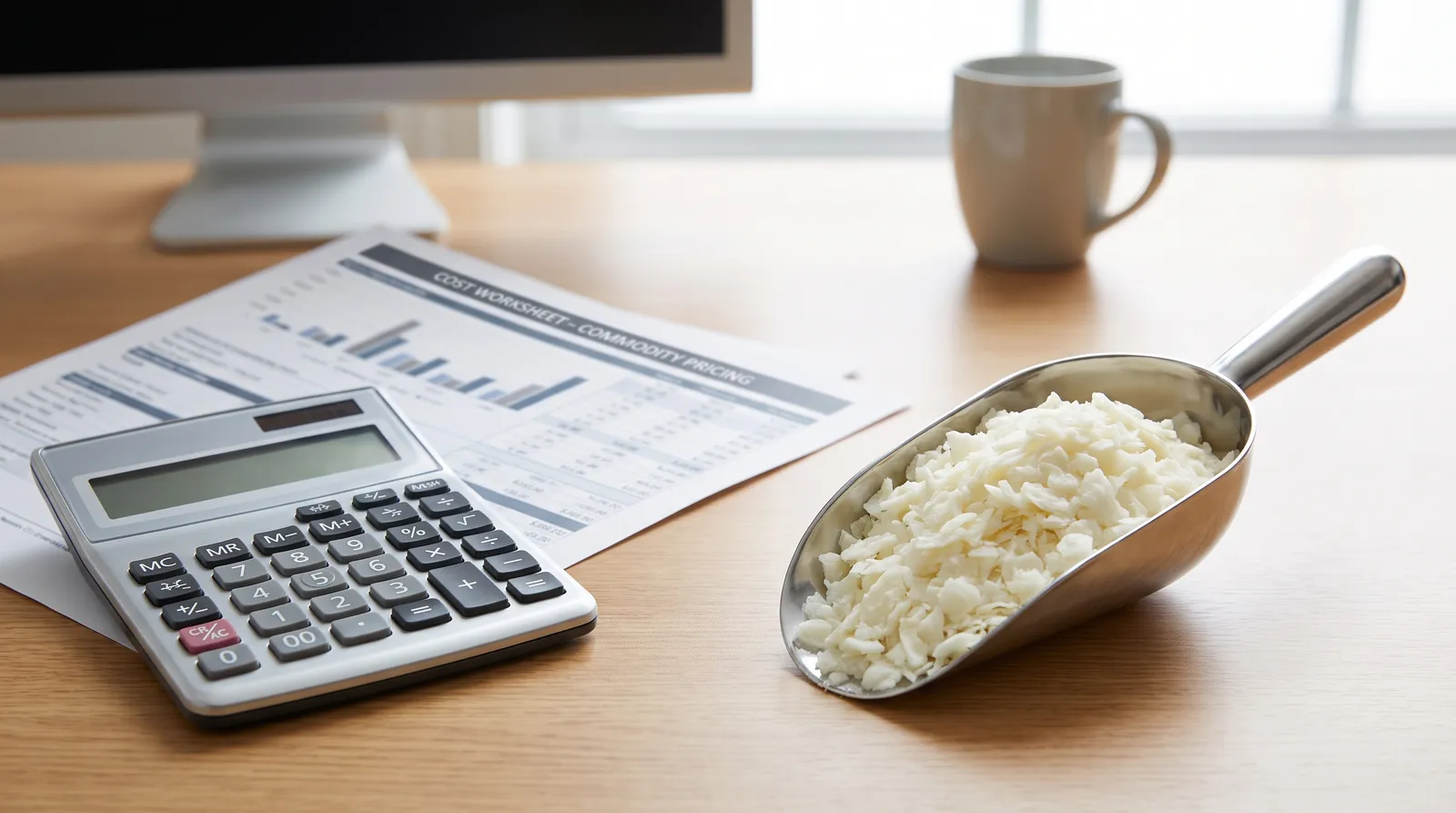
Ask five suppliers for a potato flakes “price per ton” and you will receive five numbers that cannot honestly be compared. One is FOB, one is CIF, one assumes a spot shipment in June, one assumes an annual programme signed in February, and one quietly specifies a coarser granulation. There is no single market price for dehydrated flakes — there is a cost model, and once you understand it, every quote you receive starts to make sense. This guide walks through that model as we build it ourselves.
The cost stack behind every quote
| Component | Rough share of cost | What moves it |
|---|---|---|
| Raw potatoes | Largest single share | Harvest size and quality, contract-farming coverage, cold-store rates later in the year |
| Energy & steam | Second major share | Fuel prices — drum drying is steam-hungry, so energy markets feed straight into flake cost |
| Labour & plant overheads | Moderate, stable share | Local wage levels, plant utilisation — a full order book spreads fixed cost thinner |
| Packaging | Small but visible share | 25 kg kraft bags with food-grade liner as standard; nitrogen flushing and oxygen-barrier liners cost more |
| Inland & ocean freight | Varies most by destination | Lane, season and container rates — the gap between FOB and CIF quotes |
| Compliance & certification | Smallest share | Audits, per-batch testing, destination documents — cheap insurance, expensive to skip |
Season moves the biggest line
The raw potato is the largest single input, and its cost follows the Indian crop calendar. Harvest is concentrated in January to March, when process-grade varieties come off contract farms in Gujarat and Uttar Pradesh at their yearly low. From April onwards, production draws on cold-stored stock, and every month adds storage cost to the potato going into the drum dryer. The practical consequence for buyers: quotes gathered just after harvest reflect the cheapest raw material of the year, and an annual contract negotiated in that window locks the advantage in. A spot enquiry in November is priced off potatoes that have been sitting in a cold store for eight months.
Why Indian origin lands 15–30% lower
Indian flakes typically land 15–30% below EU or US origin on a CIF basis, and the gap is structural rather than promotional. India harvests over 55 million tonnes of potatoes a year — second only to China — so farm-gate prices sit well below European levels. Processing labour costs less. And freight to the Gulf, East Africa and Southeast Asia favours India outright: Jebel Ali is under a week’s sail from the west coast, while Rotterdam is a routine three-week lane. None of this is dumping; it is geography and scale doing what they always do. We set out the full case in why global brands are sourcing from India.
Container maths: normalise before you compare
Flakes are light for their volume, so a 20-foot container carries 12–14 tonnes — cube fills before weight does. That makes per-ton freight sensitive to how well the box is packed, and it makes Incoterms the first thing to normalise. A CIF quote to your port already contains ocean freight and insurance; an FOB quote does not, and the difference can swallow an apparent saving whole. Before ranking suppliers, restate every offer on the same basis — same Incoterm, same port, same shipment month, same packaging spec. Contracts are quoted in US dollars, so currency at least is one variable you rarely have to adjust for.
The levers a buyer can actually pull
You cannot move the energy market, but several cost lines respond directly to how you buy:
- Programme vs spot — an annual programme gives the plant predictable utilisation and you a firmer price; spot buys pay for flexibility.
- Shipment timing — contracts negotiated against the January–March harvest capture the raw-material low.
- Spec tolerance — a standard granulation and the stock 25 kg kraft bag cost less than custom grinds and nitrogen-flushed packs; check what your application genuinely needs against our specifications page before paying for headroom.
- Incoterms choice — buyers with strong freight contracts of their own often do better on FOB; buyers without them usually do better letting the exporter book on CIF or CFR.
What a serious quote discloses
A supplier confident in their cost model will show you its edges: the Incoterm and validity period, the harvest the raw material comes from, the packaging assumed, and the certifications included in the price rather than sold as extras. A bare number with none of that attached is not a lower price — it is an unpriced risk. The sample–trial-container–programme path exists precisely so both sides can test the model before committing a year to it.
If you are budgeting a 2026 programme, the fastest route to a real number is to tell us your destination port, annual volume and target spec — send us the enquiry and we will quote on a stated basis you can compare properly. For MOQ, payment terms and sampling basics, start with the FAQ.