Every bag of dehydrated potato flakes starts as ordinary potatoes — and what separates a consistent, food-safe industrial ingredient from home-dried mash is everything that happens in between. Here is the process as it runs on a modern drum-drying line, step by step.
1. Selection of quality potatoes
Flake quality is decided in the field. Processing varieties are chosen for high dry-matter content and low reducing sugars — the traits that give good yield and a clean colour after drying. Incoming lots are inspected for size, damage and rot before they enter the line; at 3Brothers this starts even earlier, with contracted farms and controlled cold storage across our value chain.
2. Washing and peeling
Potatoes are washed to remove soil and stones, then peeled — typically by steam, which flashes the skin off with minimal flesh loss. Peeled potatoes are inspected again, and any remaining defects are trimmed out.
3. Steam cooking
Slices are cooked with steam until the cell structure softens evenly. Cooking is a controlled step, not a boil-until-done: temperature and time determine the texture, colour and flavour of the finished flake.
4. Mashing
The cooked potato is mashed into a smooth, uniform purée. Uniformity matters — lumps or unevenly cooked pieces show up later as defects in the dried sheet.
5. Drum drying
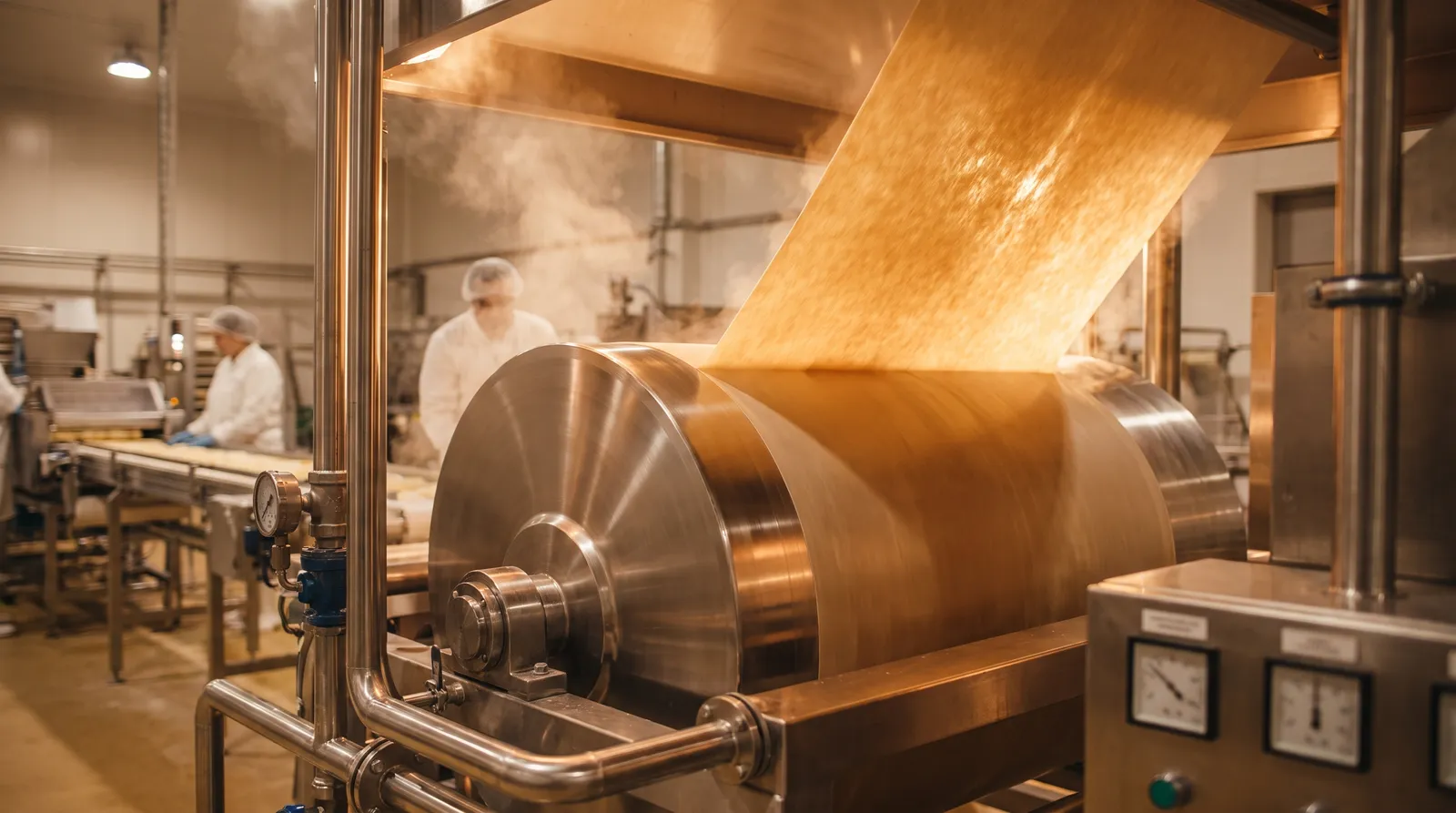
The purée is applied in a thin film to a slowly rotating, steam-heated drum. Within a single revolution the film dries to a low-moisture sheet and is lifted off by a doctor blade. Drum drying is what defines a “flake”: the potato’s cooked cell structure is preserved in a form that reconstitutes almost instantly.
6. Flake formation
The dried sheet is broken into flakes of consistent size and thickness. Granulation can be tailored — some applications want large, visible flakes; snack processes often prefer a finer, more uniform cut.
7. Quality inspection
Samples from every batch go to the laboratory: moisture, colour, defects, rehydration behaviour and microbiological parameters are checked against specification. The lab, not the production schedule, releases the batch — the numbers a buyer sees on the Certificate of Analysis come from this step. Typical parameters are listed on our specifications page.
8. Hygienic packaging
Released flakes are packed into multi-wall kraft bags with a food-grade liner, sealed, metal-detected and palletised for dispatch. Packaging protects the flake’s low moisture — the property that gives it a 12–18 month shelf life without refrigeration.
Why the process matters to buyers
Two suppliers can both say “potato flakes” and deliver very different ingredients. Cooking control decides flavour; drum parameters decide density and rehydration; inspection discipline decides whether batch fifty behaves like batch one. When you audit a supplier, you are really auditing these eight steps — see how we run them on our manufacturing page.