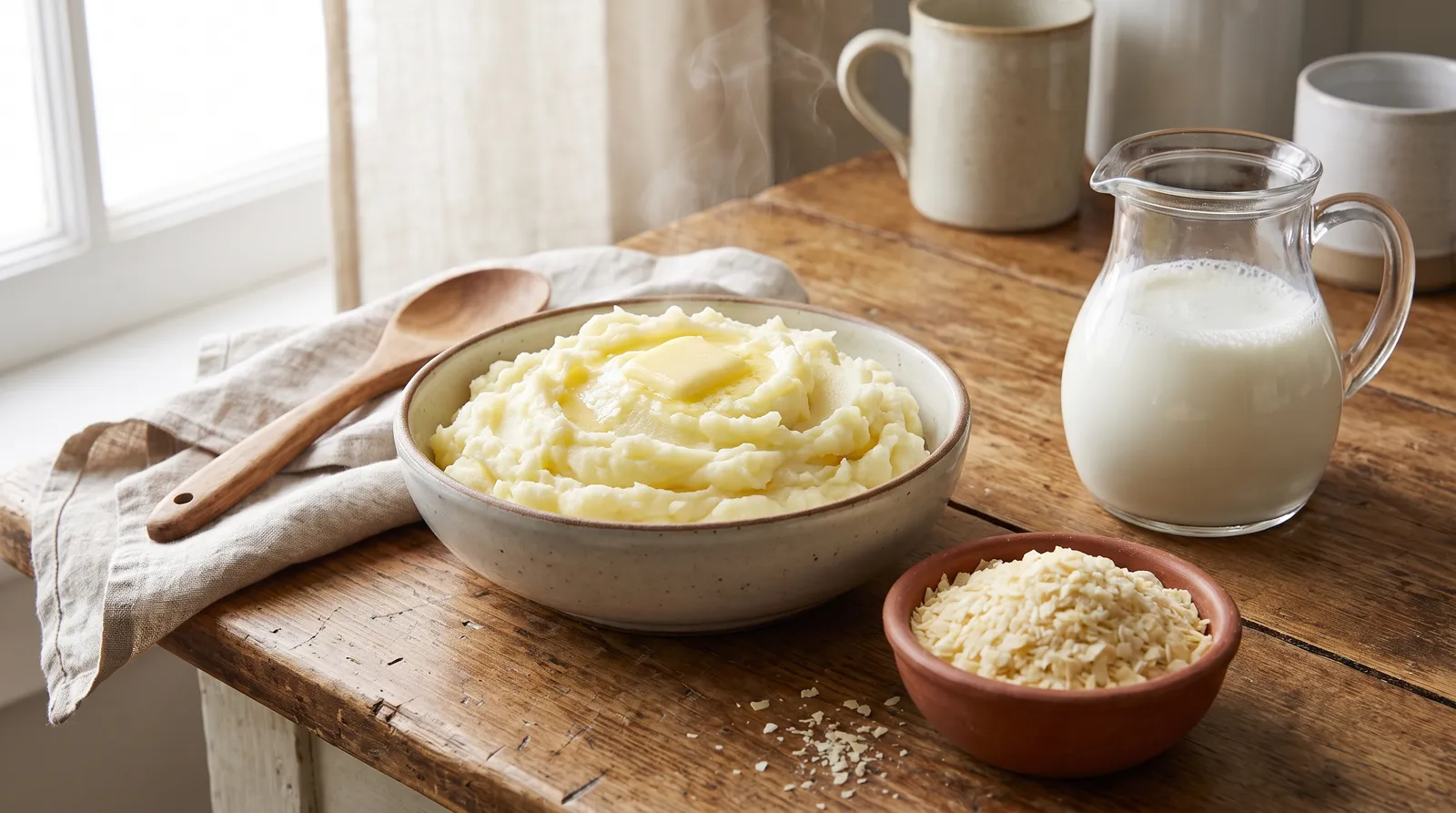
Reconstituting potato flakes is simple — which is exactly why it goes wrong so often. The flake does the work; your job is to give it the right amount of hot liquid and then leave it alone. Here is the method, the ratios, and the mistakes that turn fluffy mash into glue.
The basic ratio
As a starting point, use roughly 1 part flakes to 4–5 parts hot liquid by weight. One kilogram of flakes yields around 4.5–5.5 kg of finished mash depending on the texture you want — firmer for forming and piping, softer for purées and soups. Exact absorption varies by grade, so confirm against the supplier’s technical data sheet and adjust to your line.
The method
- Heat the liquid first. Water, milk or a blend, at roughly 80–90 °C — hot but not at a rolling boil.
- Season the liquid, not the finished mash: salt and fat (butter or oil) disperse evenly this way.
- Add flakes to liquid — pour them in, distribute gently, and let them stand 30–60 seconds to absorb.
- Fold, don’t beat. A few gentle strokes to homogenise. Then stop.
Why over-mixing makes glue
A potato flake preserves cooked potato cells. Rehydrated gently, those cells swell and sit against each other — that is fluffy mash. Vigorous or prolonged mixing ruptures the cells and releases free starch, and free starch is exactly what wallpaper paste is made of. The gluey-mash failure is almost never the flake: it is the mixer. On production lines, this means minimising high-shear stages after hydration.
Common mistakes
- Liquid too cool — flakes hydrate slowly and unevenly; the mash reads lumpy.
- Flakes added too early to boiling liquid on heat — continued cooking plus stirring shears the cells.
- Adjusting texture with more mixing — adjust with liquid, never with agitation.
- Ignoring standing time — the 30–60 second absorption pause does the real work.
Industrial applications
In snack and dough applications the “reconstitution” happens inside the process — flakes are blended dry and hydrate during dough formation or extrusion. The same principles carry over: control water temperature, give hydration time, and keep shear as low as the process allows. Granulation matters here too; a custom grind can hydrate more evenly in fast dough systems, which is one of the customisations in our product range.
Want to trial it properly? Request a sample with your application noted, and we’ll send the matching technical data sheet — typical parameters are on the specifications page.