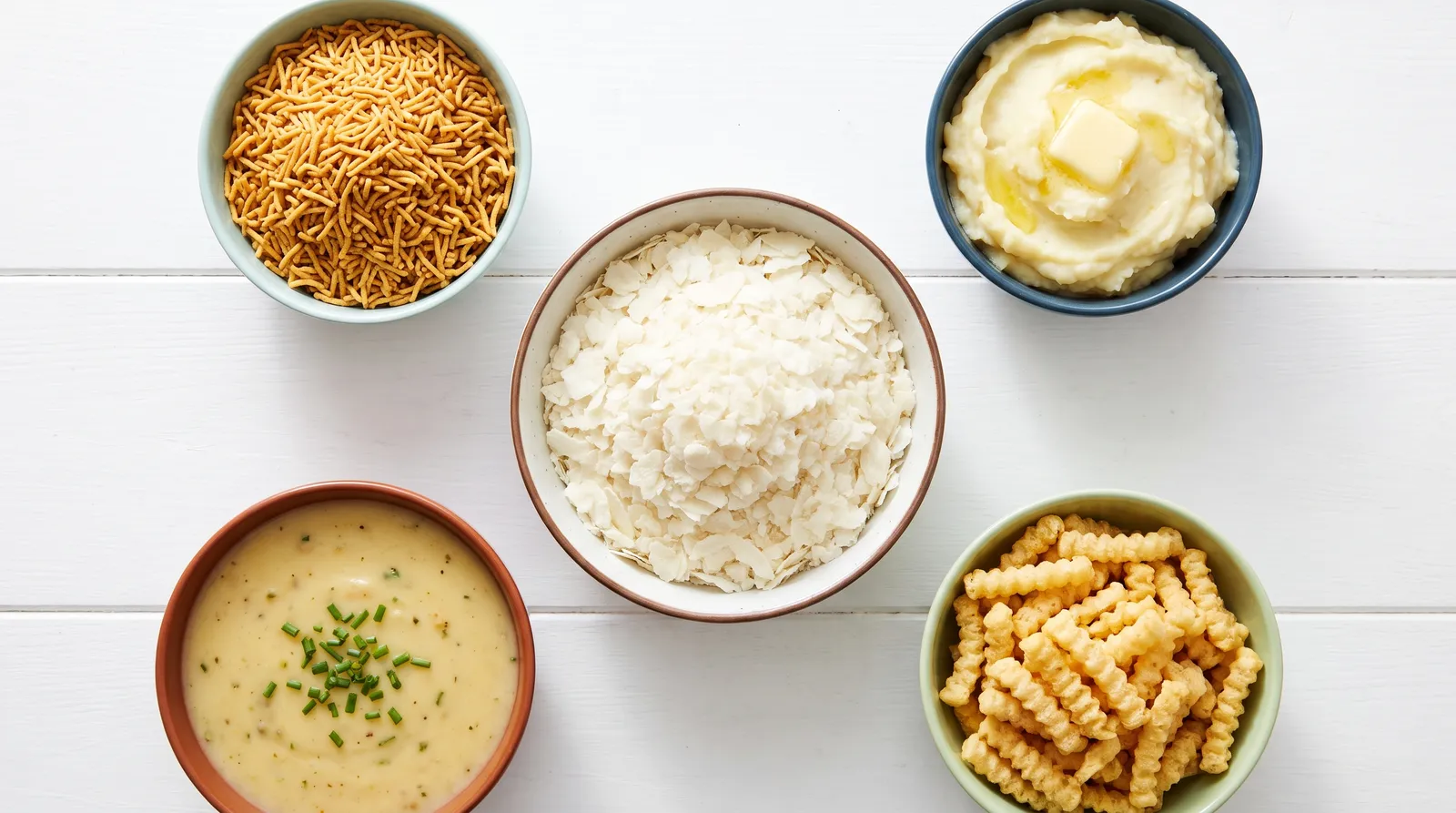
Ask anyone what potato flakes are for and you will hear the same answer: instant mash. Yet on a manufacturer’s order book, mash is a minority line. Most flake tonnage disappears quietly into extruded snacks, namkeen doughs, soups, ready meals, bakery mixes and coating systems — applications where the buyer never says the word “mash” at all. Here are the twelve industrial uses we supply most often, and for each one, the specification parameter that decides whether the flake performs.
Five parameters, twelve jobs
Every application below turns on one of five measurable properties: granulation (particle size distribution), cold-water solubility (how readily the flake hydrates), bulk density (weight per litre, which governs dosing and freight), moisture (held below 8% for stability and predictable water addition) and colour (creamy white to pale yellow, free of dark specks). If you are still deciding between flakes and their cousins, our comparison of flakes, granules, powder and starch is the place to start; typical values for each parameter sit on the specifications page.
Snacks and extrusion
Snacks are the biggest single sink for flake tonnage. High-dry-matter, low-sugar process varieties such as Chipsona and Lady Rosetta produce a flake that fries pale and expands well — which is exactly what these four applications ask of it.
- Extruded snack pellets. Flakes supply pre-gelatinised potato solids that flow through the die and expand cleanly on frying or hot-air puffing. Watch granulation — an uneven particle size feeds the extruder erratically and shows up as inconsistent expansion.
- Fabricated and stackable crisps. Sheeted potato doughs need cooked cells that hydrate into a cohesive, machinable sheet with genuine potato flavour. Watch cold-water solubility, which governs how quickly and evenly the dough comes together.
- Aloo bhujia and namkeen doughs. Flakes replace boiled, mashed fresh potato in the besan dough, taking peeling, boiling and seasonal variability off the production line. Watch moisture — a stable figure below 8% keeps water addition identical batch to batch.
- Snack seasoning and binder blends. Finely milled flake carries seasonings onto the base snack and binds them there, contributing potato flavour rather than acting as a neutral filler. Watch granulation: the grind must blend without visible specking.
Meals and food service
This is the family the public knows. What these applications share is that the potato is eaten as potato — so eating quality, appearance and portion consistency lead the specification rather than machinability.
- Retail instant mash. The famous application: flakes whisk into fluffy mash at a 1:4–1:5 ratio with hot water or milk. Watch colour — the consumer eats this product plain, so creamy white with no dark specks is non-negotiable.
- Food-service mash. Hotel and quick-service kitchens dose by scoop and need identical yield at every site. Watch bulk density, because a drifting weight-per-litre quietly changes portion cost.
- Ready meals and frozen entrées. Deposited mash layers — shepherd’s pie, topped bakes — need full, rapid hydration on the line with no dry cores that surface after freeze and thaw. Watch cold-water solubility.
- Soups and gravies. Flakes thicken naturally while leaving visible, recognisable potato in the bowl — something refined starch cannot do. Watch granulation: coarser flake stays visible, fines dissolve into body.
Bakery and beyond
The quietest growth is here: applications where flake is a functional ingredient the consumer never identifies, valued for water binding, dry-matter control or a clean carbohydrate base.
- Bread and bakery. A few percent of flake softens the crumb and holds moisture through shelf life, keeping loaves fresher for longer. Watch granulation — the flake must be fine enough to disappear into the crumb.
- Gnocchi and potato dumplings. Flakes standardise dry matter that fresh potatoes never deliver twice the same, so dough consistency stops depending on the season. Watch moisture, the anchor of dry-matter control.
- Batters and coatings. Potato solids in a coating system brown evenly and add crispness and flavour to fried products. Watch colour: a pale, speck-free flake fries to a clean, uniform golden coat.
- Baby food and nutrition blends. Flakes provide a bland, easily digested carbohydrate base for infant and clinical formulations. Watch the microbiological limits — total plate count, yeast and mould, E. coli and Salmonella — specified tighter than standard food grade, and verified on every batch CoA.
Matching the grade to the job
Twelve applications do not need twelve products — they need one well-made flake supplied at the right granulation. A bakery blend and a soup want different particle sizes from the same drum-dried sheet, which is why we offer customised granulation as part of our product range: tell us the application and we mill and screen to suit, rather than leaving you to grind a standard flake in-house. The same discipline applies to the other parameters — a baby-food buyer gets tighter microbiological limits written into the specification and verified per batch, while a snack extruder gets a granulation band held shipment after shipment.
If one of these twelve is your product — or the thirteenth we have not listed — send us the application and your target spec. We respond with a matching data sheet and samples, and support trial orders before any annual programme.